A pre-term delivered infant is at greater risk for health complications. The microbiota of a pre-term baby is less stable than that of a baby born at the right term. The health risks that pre-term delivered babies face are related to the differences in the gut microbiota.
When a baby is born earlier than week 37, we talk about premature birth. A pre-term delivered baby is prone to health complications, more susceptible to infections (which are more dangerous as their immune system is not ready to face them yet). We know that the microbiota can play a role in the defense against pathogens. The microbiota development is affected by the birth mode, nutrition, environment and medication. All of these factors are not only associated with the microbiota, but also with the newborn physiology, growth and development. Some infants are at higher risks of different microbiota development because of the c-section delivery, antibiotic use and formula feeding (and/or sometimes enteral feeding also). All of these are common traits for pre-term delivered babies. Every one of these factors can lead to sub-optimal conditions for the microbes living in the intestines, so the microbiota of a pre-term born baby is less stable that that of a baby delivered in term. The immediate risks of a premature baby microbiota composition are the increased risk of sepsis and of necrotizing enterocolitis (NEC). All of these infections are life threatening for the baby. There is a direct correlation between the microbiota colonizing rate and the gestational age (meaning that the infants born at younger gestational age got less colonizing microbes).
Another major issue is related to the colonization with Bifidobacteria, which is delayed in pre-term born infants. The duration of the antibiotic treatment is associated with the delayed colonization too, as treating the premature baby with antibiotic form one to seven days will directly affect the colonization rate of Bifidobacteria. The longer the treatment, the longer it takes for Bifidobacteria to start colonize the intestine. To add to this problem, the respiratory support seems to prevent strictly anaerobes such as Bifidobacteria to colonize the intestinal tract. Instead, facultative anaerobes and aerobic bacteria could be present, many of them being opportunistic pathogens. This can contribute to higher risks of infection. The delay in the colonization with Bifidobacteria can be linked to nutritional status, as the lack of it can reduce the nutritional value because of the lesser degradation of the food. We all know that efficient energy uptake from food will improve the growth and development of the infant. All of these pre-term babies have increased colonization by potential pathogens and a delay/decrease colonization of Bifidobacteria.
Awareness of the possible benefits of the microbiota composition for pre-term born infants will help to develop strategies to improve health status of this vulnerable group of children.
Next post will be about the antibiotics effects on the microbiota.
The way you are born determines how your microbiota develops. A child who is born naturally will have a different microbiota than a child who is born via c-section. A c-section child will have less diverse microbiota, so their guts will contain fewer different microbes. These differences in microbiota related to the mode of birth are present only early in life, but they have potential risks later in life: allergies, asthma, type 1 diabetes and obesity.
Why, would you ask? One hypothesis is that different microbes colonizing the babies' gut have different effects on the immune system development. The window of opportunity to train and develop your immune system health may be different for natural born and c-section born children. Another hypothesis is that mom's gut microbes are already selected and deemed safe, being also beneficial for food digestion, decreasing the risk of exposure to pathogens and increasing the chance of beneficial food degradation in the child's intestine.
The mode of delivery determines which microbes will colonize the gut right after birth, but has no effects of the microbiota existing later in life. All the correlation between mode of delivery and overall health as an adult might be possible because of the differences in the microbiota composition from the newborn's gut.
Next post will be about gestational age of microbiota.
Different developmental stages of the microbiota can be distinguished. The different developmental stages define the age of microbiota of a human being. Every increase or decrease in the microbiota age compared with the actual chronological age of a child can indicate various outcomes.
After the first microbes colonize the human body, the microbiota start to develop, over the next few years, depending on environmental factors, like food intake. First change will happen during weaning, which starts a non random process of maturation, induced by the change of the nutrient consumption. During the first phase of milk consumption we have Bifidobacteria as a dominant member of microbiome. Upon weaning, members of Firmicutes and Bacteroidetes become dominant. Microbiota reaches adult stage in 3-6 years, being fully maturated after puberty. Main markers of bacterial adulthood are already present at toddlers. The microbiota of formula fed babies is more mature compared to a breastfed child. The maturation of microbiota also happen faster at c-section born babies.
Maturation of the microbiota is directed by nutrition. Malnutrition in early stages of life can result in irreversible stunted growth and impaired cognitive ability. The microbiota of malnourished children does not mature fully. But a food intervention rescuing children from malnutrition will immediately mature the microbiota. The potential relationship between infant malnutrition and gut microbiota might contribute to food and microbial based therapies for malnourished people. Microbiota -modulation strategies could help restore infant growth and developmental problems. Increase or decrease of microbiota age in comparison with chronological age of the child can be used to find different health outcomes. Immature microbiota is associated with malnutrition, while faster maturation is associated with formula feeding and c-section birth. Because of all these reasons, microbiota-modulation can be the next-step strategy supporting personalized nutrition and microbiota based strategies.
The idea behind ATOMZ project, as it is underlined in the Whitepaper, is: How can one invest easily in cryptocurrencies? What if there is a software or device to signal us the best coin to buy or sell at the present moment? There are 1600+ coins to choose, but only the less known ones tend to accumulate wealth quickly, even if they are hard to track. Today is much easier to buy bitcoin, but some altcoins are still hard to buy. We all know that is good to buy low and sell high, but with the new crypto you never know if a project will fail completely after you buy low or will rise and rise long after you sell at what you were thinking is an all time high. Storage is another problem to solve, and these days if an exchange is hacked, chances to get your crypto back are quite low (see Mt. Gox case, one of the first hacked exchanges who did not pay back yet). Automated trading is another issue at hand, and it is hard to do it, as the good trading bots are quite expensive, not very transparent, not on the cloud (private servers instead) and not very customizable.
The Atomz project aims to make investing easy while generating profit. The proprietary software will analyze trends, rate the cryptocurrencies and determine the best to buy or to sell at any given moment. Help will be available for the beginners. You need to understand that the more blockchain technologies will be available and reach customers safely, the more acceptance they will gain and more value will be created.
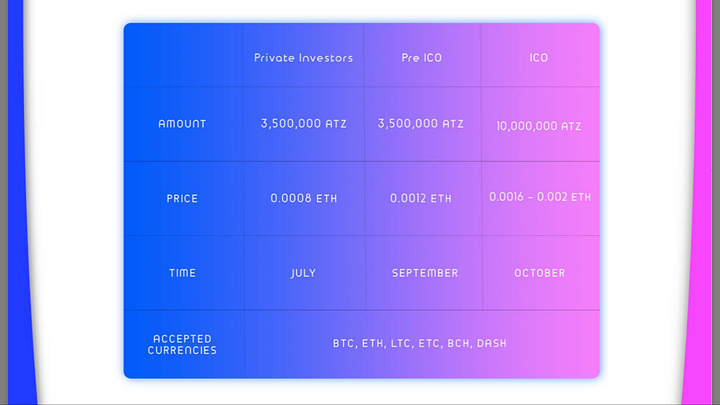
The token symbol is ATZ, and the time of the token generation event is not yet known. There will be three phases, first for private investors, 2 millions ATZ at the price of 0.40 USD, second phase for pre-ICO, 3 millions ATZ at the price of 0.60 USD and the last phase, the ICO, with 10 millions ATZ, at the price of 0.8–1 USD. The accepted cryptocurrencies for payment are BTC, ETH, LTC, ETC, BCH and DASH.
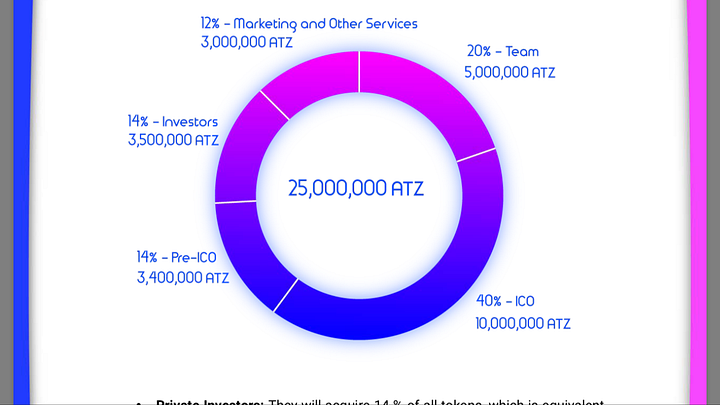
The allocation for the tokens will be done like this:
20% team (5 millions ATZ)
40% ICO (10 millions ATZ)
14% pre-ICO (3.4 millions ATZ)
14% investors (3.5 millions ATZ)
12% marketing and other services (3 millions ATZ)
All unsold tokens will be locked for one year and sold later.
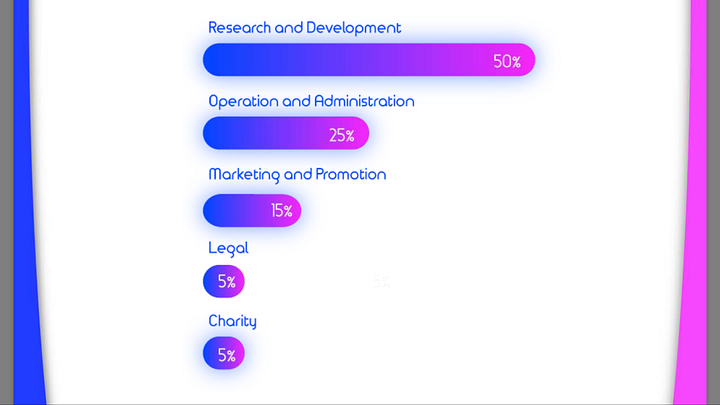
Funds distribution will be done like this:
50% research and development
25% operations and admin
15% marketing
5% legal expenses
5% charities.
Let’s take a look at their Roadmap. They started in November 2017 making the journey from idea to first software development, after the team was made. The first functional base software for advice tier and the token sale preparation began in April 2018. In August 2018 they started to recruit private investors and partners to help with the ICO and product development. In November 2018 the pre-ICO sale was organized, to bring additional funds for the project and gain a functional user base. Next steps to follow are:
12.2018 -launch of the ICO public sale and the growth of the Atomz platform;
2.2019 -end of the Atomz ICO, software improvements and team new members if needed, marketing and exchange listing;
6.2019 -closed beta launch, feedback and software improvements;
7.2019 -growth of the platform and new partnerships;
9.2019 -open-beta platform testing and optimizing (community voting, decentralized login/token login, limited user base).
The final product will have 3 tiers (cryptocurrency advice, cryptocurrency mutual funds like, cryptocurrency trading bot). Regarding the cryptocurrency advice, they want to be able to determine the best crypto to buy and sell at any given moment. The cryptocurrency packs, similar with mutual funds, with price being determined automatically. There will be different types of packs: top packs, techno packs, market cap packs. The trading bot is utilizing Atomz index, choosing custom strategies, blacklisting cryptocurrencies if needed, making investing easy and safe.
They claim to use different trends like RSI (relative strength index -to detect if the market is oversold or overbought), MACD (moving average convergence divergence -to detect trends), Bollinger bands to add reliability to RSI and MACD, market cap proportions. There are risks associated with this, the market crash being the biggest risk, adjusted by news investigation, done manually and by AI. Another risk is related to the data gathering -right now it takes 15 minutes to analyze top 100 cryptocurrencies, in the future can go up to 2 hours.
The access to the Tiers can be achieved by paying ETH equivalent of the fee in ATZ. Tier 1 is 0.16 ETH (80 ATZ), Tier 2 is 0.32 (160 ATZ) and the Tier 3 is 0.64 ETH (320 ATZ). Mutual packs and the trading bot can be bought using only ATZ tokens.
To find more about them, you can check the links to Atomz social media:
Got my first company at 16, more than 20 years ago. Just a market stall, but still paid all my university expenses. Accountant for 10 years, then, one day i felt enough is enough, and i left everything. Changed countries, start working in healthcare, 6 years from now, advanced from NVQ 1 to 5. Meanwhile i studied yoga for more than 20 years, learn few languages, studied finances and economy trends, become an angel investor on small scale, start to learn about start-ups, shares, bonds, real estate and other boring stuff. Aiming for Tim Ferris four hour workweek, but I'm not quite there. Training towards a life coach, therapist and motivational speaker career. And all that when I'm still travelling around the world, going to any seminar or movie I'm interested to see, being in a meaningful relation and doing exercises few times a week. In my peak state i am an unstoppable genius, in my lowest I'm just a lazy guy who like to watch Game of Thrones or play LoL / HoS / Hearthstone. Average person with amazing skills in a crisis situation. Have driving licence but do not like to drive. Anything except maybe an ATV. Still need to learn Chinese, jump with parachute and play an instrument.



 Posts
Posts


